
Amlogic S905Y5 vs Allwinner H626: Which 4K TV Box Platform Fits Your Project?
When selecting a processor for a TV box, there are far more factors to consider than just the chip's name. For IPTV operators, distributors, or digital signage system integrators, the final device must be capable of playing designated content, maintaining a stable connection, and supporting the intended software applications. An effective way to compare the Amlogic S905Y5 and the Allwinner H626 is to look at two actual X96 products: the X96 NEX (powered by the Amlogic S905Y5) and the X96 Lite (powered by the Allwinner H626).
Both models run on Android 14 and support 4K video playback with AV1, H.265/HEVC, and VP9 decoding. Their primary differences in published specifications lie in wired network connectivity and USB interface configurations.
S905Y5 vs H626: Comparison at a Glance
| Feature | X96 NEX: Amlogic S905Y5 | X96 Lite: Allwinner H626 |
|---|---|---|
| CPU | Quad-core Arm Cortex-A55 | Quad-core Arm Cortex-A55 |
| GPU | Arm Mali-G31 MP2 | Arm Mali-G310 |
| OS | Android 14 | Android 14 |
| Video decoding | AV1, H.265 and VP9 up to 4K at 60 fps; H.264 up to 4K at 30 fps | AV1, H.265, VP9 and AVS2 up to 4K at 60 fps; H.264 up to 4K at 30 fps |
| RAM and ROM | 2 GB or 4 GB RAM; 16 GB or 32 GB storage | 2 GB or 4 GB or 8GB or 16 GB RAM; 16 GB, 32 GB or 64 GB storage |
| Ethernet | 100 Mbps | 1,000 Mbps |
| USB | USB 2.0 | One USB 3.0 and two USB 2.0 ports |
| Wireless | Wi-Fi 6/Bluetooth 5.x | Wi-Fi 6/Bluetooth 5.0+ |
| Video output | HDMI up to 4K at 60 Hz | HDMI up to 4K at 60 Hz (HDMI 2.1 TMDS) |
| CEC | Support CEC | Support CEC |
The above details the default specifications for the X96 NEX and X96 Lite. Specifications regarding interfaces, wireless modules, memory, and firmware may vary depending on OEM/ODM designs; this table does not cover all possible implementation configurations for these two SoCs.
What Both Platforms Have in Common
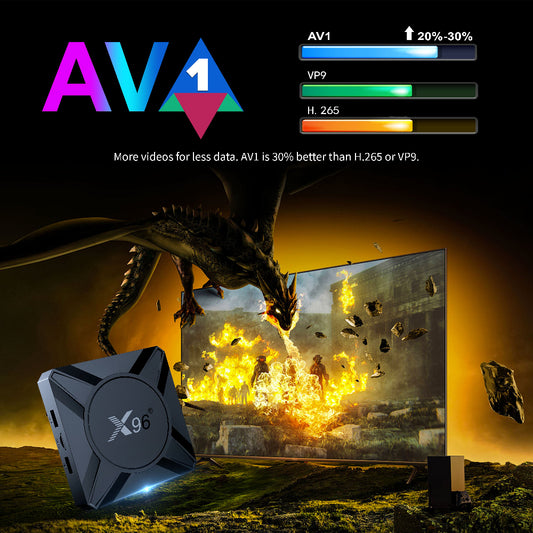
As content providers increasingly utilize the AV1 codec for efficient 4K video streaming, device-level support for AV1 has become crucial. Both X96 models are rated to support 4K@60fps decoding for AV1, H.265, and VP9 formats, as well as 4K@30fps decoding for H.264. This makes them suitable for modern IPTV and OTT video playback; however, actual performance depends on the specific video streams, media players, and firmware used.
Additionally, both models feature a quad-core Cortex-A55 processor and run on Android 14. While their specifications are identical, this does not guarantee identical performance when running specific applications. Factors such as launcher design, RAM, storage capacity, firmware optimization, and system load all influence actual performance. Therefore, performance assessments should be based on real-world testing of the final units. Please contact us if you would like to conduct testing.
Which One Should You Choose?
When comparing quotes for high-volume OEM orders, it is essential to ensure consistency across all specifications—such as RAM, storage capacity, Wi-Fi modules, accessories, and certification coverage. The price of the final product is not determined solely by the SoC model. These hardware specification differences are critical for scenarios involving local media playback, networked digital signage, and deployments with extensive peripheral integration.
Questions to Resolve Before Production
For any given platform, please use mass-production-standard prototypes to verify the target IPTV or digital signage application, specific video streams, HDMI output modes, Wi-Fi and Ethernet connection stability, thermal performance, OTA upgrade processes, and long-term playback performance.
Click here to learn more about our factory quality control processes.
X96 can discuss OEM/ODM options for the S905Y5-based X96 NEX and the H626-based X96 Lite. Send us your application, target market, order volume and must-have interfaces, and we can propose a configuration to test.