
Allwinner H626 vs H618 SoC: Full Spec Comparison for TV Box & Digital Signage
If you’re sourcing Android TV boxes, commercial digital signage, cloud game players or 4K media streaming devices, you’ve likely encountered two mainstream Allwinner processors: H626 (mid-high tier) and H618 (entry-level budget). Many buyers struggle to tell their core differences, performance gaps and suitable application scenarios.
This full comparison breaks down every hardware parameter, decoding capability, interface and power performance to help you pick the right SoC for your product line.

1. Manufacturing Process & CPU Architecture (Core Performance Gap)
The manufacturing process and CPU core directly decide raw performance, power consumption and heat generation.
Allwinner H626
- 22nm advanced fabrication process
- Quad-core Cortex-A55 + single RISC-V E902 auxiliary core
- Default 1.8GHz clock, power-saving locked at stable 1.6GHz for daily operation
- Full L1+L2+L3 multi-level cache design
Allwinner H618
- Older 28nm process
- Quad-core Cortex-A53 only, no auxiliary RISC-V core
- Max 1.5GHz fixed frequency
- Only L1+L2 cache, no L3 cache
Key Difference
Cortex-A55 architecture delivers better energy efficiency than A53, paired with smaller 22nm silicon. H626 runs smoother under multi-task loads while generating less heat and drawing lower power.
2. RAM & Memory Bandwidth (Biggest Bottleneck of H618)
Memory capacity and bandwidth determine multi-task fluency, critical for commercial signage running multiple apps simultaneously.
Allwinner H626
- Supports LPDDR3 / DDR4 / LPDDR4 / LPDDR4X dual-channel memory
- Max expandable RAM up to 16GB LPDDR4X (X96 factory recommended 2GB/4GB for mass production)
- DDR frequency ceiling: 792MHz (1866MHz spec)
- Supports 32-bit & 64-bit Android OS, wider memory addressing range
- EMMCP matching options: 1.5GB+8GB / 2GB+16GB, fully compatible with Android 14
Allwinner H618
- Only DDR3 / LPDDR3 / DDR4 / LPDDR4 support
- Hard physical limit: maximum 4GB RAM (32-bit addressing cap at 4GB total space)
- DDR frequency capped at 600–648MHz, limited by internal DRAM controller
- Can run 64-bit OS but suffers severe performance lag under heavy loads
Key Difference
H626 unlocks large memory configurations for multi-window commercial screens, cloud gaming and long-time background streaming; H618 is restricted to lightweight single-task budget devices only.
3. HDMI Display Output & CEC Function
Allwinner H626
- HDMI 2.1 TMDS standard (equivalent to HDMI 2.0 bandwidth, no FRL high refresh rate support)
- Full, stable HDMI CEC control function for TV one-key linkage
Allwinner H618
- Limited to pure HDMI 2.0 mode
- Incomplete CEC function, unstable TV remote control linkage
Key Difference
For home media boxes and commercial display screens requiring TV control synchronization, H626’s full CEC is a must-have upgrade.
4. Multimedia Hardware Decoding (AV1 Is The Game Changer)
Video codec compatibility directly affects streaming platform certification and 4K high-bitrate playback.
Allwinner H626
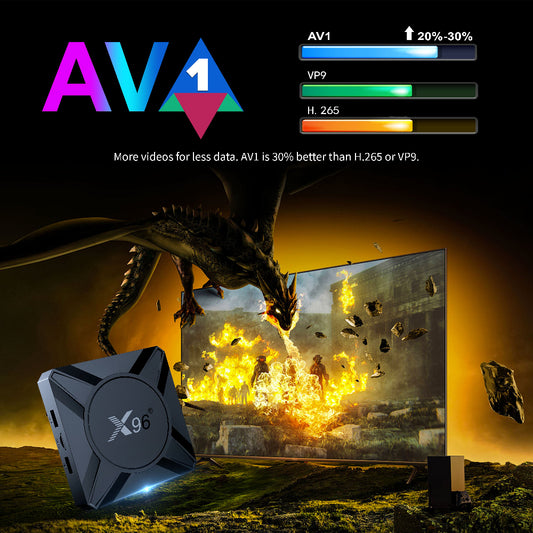
- Native hardware AV1 decoding support
- Eligible for Google YTS official certification (only AV1-capable chips pass the audit)
- Smooth playback of modern streaming AV1 high-efficiency video sources
- Full 4K@60fps H.265 hardware acceleration
Allwinner H618
- No AV1 hardware decoding at all
- Only basic H.265 4K@60fps decoding, cannot process AV1 video natively
- Unable to apply for Google YTS certification
Key Difference
H626 fits premium streaming devices targeting Netflix, YouTube 4K AV1 content; H618 only works for local video playback without modern streaming certification demands.
5. Peripheral Interfaces (USB 3.1 Is A Major Upgrade)
USB Port
- H626: USB 3.1 (5Gbps high-speed) + USB 2.0. USB3.1 meets 5G SIM card & high-speed data transfer requirements, bandwidth over 100MB/s
- H618: Only USB 2.0 ports, slow file transfer speed
Network & Storage
Both chips integrate Gigabit GMAC Ethernet and support eMMC flash storage. H626 features higher storage bandwidth and compatibility with larger-capacity eMMC chips for commercial long-time playback.
6. GPU Graphics Performance
- Allwinner H626: Mali-G310 next-gen GPU, optimized under 22nm process, better graphic rendering for cloud games & UI animation
- Allwinner H618: Mali-G31 basic GPU, weak on heavy UI and light gaming loads
Key Difference
H626 delivers smoother cloud gaming, split-screen advertising UI and complex 4K graphic overlays; H618 lags on multi-layer display interfaces.
7. Power Consumption & Thermal Control
- H626: 22nm advanced process, lower power draw under identical load, less heat buildup
- H618: 28nm old process, higher thermal output, easier thermal throttling under long-running signage tasks
Key Difference
Devices built with H626 can adopt smaller passive cooling solutions, reducing product casing cost and noise for commercial all-day operation.
8. Full Comparison Table (Quick Reference for Buyers)
| Spec Item | Allwinner H626 | Allwinner H618 |
|---|---|---|
| Process | 22nm | 28nm |
| CPU | Quad A55 + RISC-V E902, 1.6–1.8GHz | Quad A53, max 1.5GHz |
| Max RAM | Up to 16GB LPDDR4X (2GB/4GB recommended) | Hard limit 4GB total |
| DDR Max Freq | 792MHz | 648MHz |
| HDMI | HDMI2.1 TMDS, full CEC | HDMI2.0, broken CEC |
| AV1 Decode | Hardware supported, support YTS certifiable | No AV1 hardware decode |
| USB | USB3.1 + USB2.0 | Only USB2.0 |
| GPU | Mali-G310 | Mali-G31 |
| OS Support | 32/64-bit Android 14 stable | 32-bit preferred, laggy 64-bit |
| Use Position | Mid-high end media box, commercial signage, cloud game player | Entry budget TV box, lightweight simple signage |
9. Which Chip Should You Choose?
Pick Allwinner H626 If Your Product Fits:
- Premium 4K Android TV boxes targeting global streaming services (YouTube, Netflix AV1 content)
- Commercial digital signage running split-screen multi-app 24/7
- Cloud game media players requiring high GPU & USB3.1 speed(5G mobile network module via USB 3.1 adapter)
- Products needing Google YTS certification
- Devices requiring stable HDMI CEC TV linkage
- Long-running equipment with strict low heat & low power requirements
Pick Allwinner H618 If Your Product Fits:
- Low-cost entry-level basic TV boxes for local video playback
- Simple single-screen advertising boards with light task loads
- Budget streaming devices without AV1/YTS certification requirements
- Cost-sensitive mass entry-level consumer electronics

10. Final Verdict
Allwinner H626 is a fully upgraded successor to H618 with comprehensive advantages across process, memory, decoding, interface and power efficiency. H618 remains a cost-effective entry choice only for ultra-budget simple playback devices.
For merchants selling mid-to-high tier media players and commercial signage, H626 brings stronger product competitiveness, wider software certification compatibility and longer service life for all-day commercial operation.